
HPA forecasts 2027 pig prices: flat outlook with an oversupply warning if herd expansion accelerates
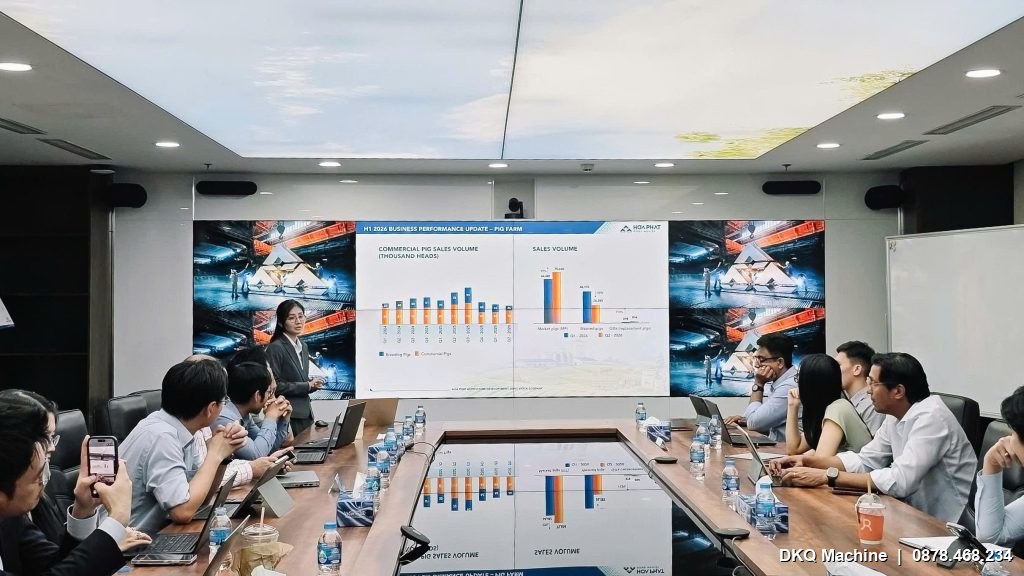
Live hog prices are sitting in a low range, and the rapid rebuilding of Vietnam’s pig herd is drawing close attention from investors. At an investor meeting held on 13 August in Hanoi by Vietcap Securities together with Hoa Phat, leaders of Hoa Phat Agriculture JSC (HPA) said pig prices could recover toward the end of 2026, but the 2027 price level will most likely stay flat compared with this year – and the price cycle could push the market to a trough around 2028.
The numbers back up the pressure: in the first six months, HPA’s average live hog selling price was about 66,000 VND/kg, down from more than 68,000 VND/kg in the same period last year. The decline partly reflects seasonality – the summer school break and the seventh lunar month are typically slow for consumption – but the more telling shift lies in the structure of the herd.
According to HPA, the national pig herd now stands at about 27.1 million head, close to the 28 million recorded in 2018, while the sow herd is around 2.1 – 2.2 million. Notably, smallholder production has shrunk markedly over the past two years: many small farms have nearly stopped keeping sows and switched to short-cycle fattening, buying piglets from large enterprises. Ever-stricter environmental and biosecurity requirements force households that want to stay in business to invest more in barn infrastructure, pushing market share toward large-scale, closed-loop farming models.
That is why HPA issued a warning: if major enterprises roll out their herd-expansion plans all at once, oversupply will be hard to avoid, and Vietnam could repeat China’s scenario within the next 2 – 3 years – where supply fell into a glut lasting more than four years after the aggressive expansion wave that began in 2020. HPA itself is taking a cautious path: it plans to raise its sow herd to about 30,000 – 32,000 by 2030 from roughly 25,000 today, arguing that expanding the herd does not automatically mean higher efficiency – operational capability, staff quality and site management are the real deciding factors.
The equipment angle: a growing pig herd means rising feed demand, and that is a direct signal for domestic feed mills. As large-scale farms dominate, feed must be consistent and uniform batch after batch – which drives investment in grinding, mixing, pelleting, cooling and automatic bagging lines. DKQ’s experience at feed mills shows that pellet mills with 5 – 15 tonnes/hour capacity, mixers achieving a mixing uniformity of CV ≤ 5 – 7%, and automated bagging are the three items plants prioritise whenever they expand capacity. Conversely, when the price cycle turns down, production cost decides survival – high-efficiency, energy-saving equipment is exactly how to cut the cost per kilogram of feed, indirectly helping farmers cut the cost per kilogram of pork.
With the herd expanding at the current pace, the supply-demand equation will stay tense for the next one to two years. Smallholder farmers should be cautious before any expansion decision, while feed mills and equipment suppliers should get ready to serve the next investment wave when the cycle turns.
Source: Nha Chan Nuoi — https://nhachannuoi.vn/hpa-du-bao-gia-heo-nam-2027-canh-bao-nguy-co-du-cung-khi-tang-dan-manh/