
Fluid bed drying: why the granule batch will not dry and how to control final moisture
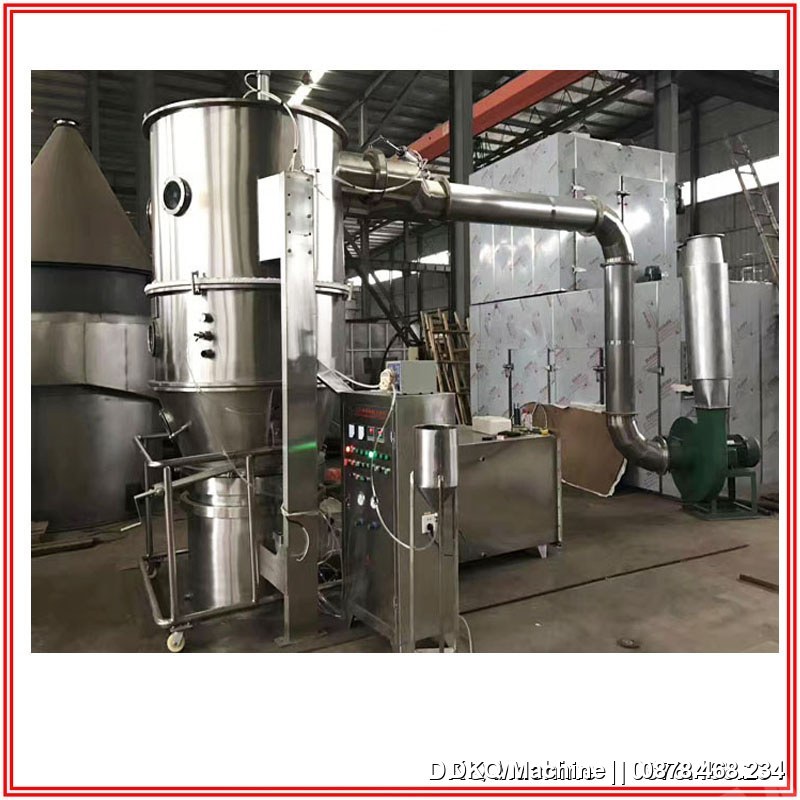
The granules will not dry. It is one of the most common reasons a batch gets scrapped or re-dried, especially for granules used in tableting or instant sachets. A fluid bed dryer (FBD) is practically mandatory after wet granulation, yet plenty of operators still end the shift asking: the machine ran for the full set time – why is the final moisture still off?
Fluid bed drying in essence forces hot air up through the granule bed at a velocity high enough to keep the particles suspended, maximising the air-particle contact area so moisture leaves quickly. Batch quality is decided by four parameter groups: inlet/outlet air temperature, inlet air humidity (dew point), airflow rate (fluidisation velocity), and the pressure drop across the bed. Get one of the four wrong and the whole batch is compromised.
For heat-sensitive products such as antibiotic granules or probiotic supplements, inlet air is typically held at 50-70°C with outlet air at 30-40°C. But in Vietnam, ambient relative humidity of 70-85% is the norm. If the inlet air does not pass through a desiccant wheel, then in the final phase, when the granules are nearly dry, the humid airstream has almost no capacity left to pull moisture out of the product, and final moisture sticks at 3-4% no matter how long you dry. Our rule of thumb: keep the inlet-air dew point at ≤ 8°C (about 6.5 g/kg absolute humidity) and monitor it online rather than manually.
The second classic mistake is running by the clock instead of by end-point. Batch moisture depends on charge weight, the moisture of the incoming wet granules, and even the weather. Two batches dried for the same 45 minutes can finish 1-1.5% apart in final moisture. The standard approach: watch the inlet-outlet temperature difference; when the outlet temperature climbs and delta T stabilises around the validated threshold (typically 25-30°C depending on the product), moisture release has become negligible – that is the moment to stop. A near-infrared (NIR) online moisture analyser is even better, but delta T remains the cheapest and most reliable indicator.
Three mechanical faults are routinely overlooked: a clogged air distribution plate that makes the airflow channel through the bed, leaving some granules wet and others dry; filter bags that are not shaken clean, raising resistance and cutting airflow mid-batch; and leaking body gaskets that let hot air escape and corrupt the whole drying profile. At one customer site running 300 kg batches of supplement granules, final moisture swung between 2.2% and 3.8%. On-site inspection found the outlet temperature sensor caked in powder, reading 3-4°C low. After cleaning the sensor, adding an online dew-point transmitter and switching the procedure to delta-T end-point control, final-moisture variation came down to ±0.3%.
When buying or upgrading an FBD, be clear about a few things: the distribution plate area and fan capacity must be sized against the true bulk density of your product – a supplier quoting capacity in water does not mean the machine will dry your granules well; the fan should be inverter-driven so fluidisation velocity can be tuned per phase (fast drying early, reduced airflow late to protect dry, brittle granules); the pulse-jet filter shaking must run on an automatic cycle; and if you want granulating and drying in one unit, choose a top-spray configuration with a binder solution system – one less transfer step and less cross-contamination risk. All temperature, humidity and differential-pressure sensors must sit in the routine calibration plan and be verified within the equipment IQ/OQ dossier.
Bottom line: fluid bed drying is not difficult – the difficulty is that plants tend to dry by habit. Control the inlet air (temperature and dew point), end each batch by end-point rather than by the clock, and keep the trio of distribution plate – filter bags – gaskets in proper condition, and final moisture will hold within a tight band – the prerequisite for uniform tablet hardness, fast-dissolving granules, and batches that pass QC on the first attempt.